DNS Filtering Built for ISP Networks

What ISPs Get With Control D
What Happens When ISPs Skip DNS Filtering
ISPs that skip DNS-layer protection leave their networks and subscribers exposed. Threats propagate, subscribers leave, regulators fine, and support costs climb. These are problems that get more expensive the longer they go unaddressed.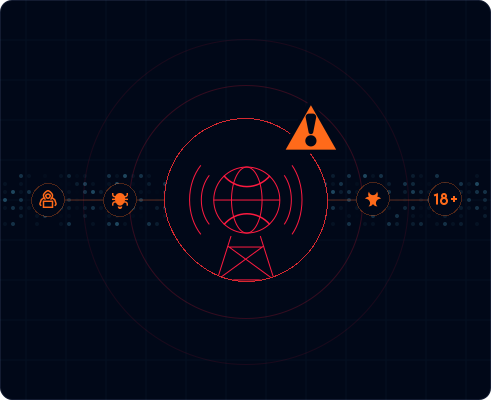
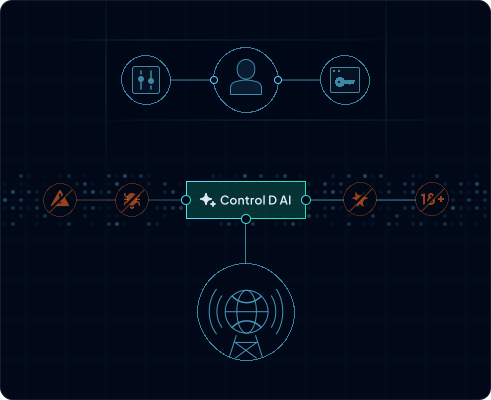
DNS Filtering Features Built for ISP Networks
How Control D Compares to Other DNS Filtering Providers
Built for Every Type of ISP

GitHub

Network Information Technologies, LLC

Pinnacle ICT
Frequently asked questions
Control D operates at the DNS layer. Point your DNS resolvers to Control D's Anycast addresses and filtering applies across your subscriber base immediately. No changes to routers, CPE, or core network infrastructure. We provide a full REST API for automated subscriber provisioning, making it easy to integrate with your OSS/BSS stack and manage profiles at scale. For ISPs that run on-prem resolvers, our open-source daemon (ctrld) can forward queries to Control D while preserving your existing DNS architecture.
Yes. Control D is built for this. Create tiered subscriber plans: basic threat protection, premium content filtering, parental controls, ad-free browsing, or any combination. Each tier maps to a Control D profile with its own filtering rules. Assign profiles through the dashboard or automate the entire flow via API. ISPs can configure which settings subscribers are able to adjust within their own profiles, while enforcing baseline protections at the network level.
Yes. Control D supports category-based and domain-level filtering that can be configured to meet local regulatory requirements, including mandatory parental controls (e.g., Italy's 2024 legislation), content blocking orders, and age verification mandates. Query logs are retained for one month and exportable as CSV for compliance audits. For real-time compliance monitoring, stream logs to your SIEM via our Fluent Bit integration.
No. Control D uses a globally distributed Anycast network. DNS queries route to the nearest healthy node, delivering low-latency resolution times. Independent testing shows single-digit millisecond response times, competitive with major public resolvers. Subscribers experience no perceptible slowdown.
Each subscriber (or household, or business account) gets their own filtering profile with custom rules. Profiles can include content filtering categories, service-level controls (block or allow specific apps), parental controls, and time-based scheduling rules. Control D also supports dual-profile assignment: enforce a network-wide ISP baseline plus a subscriber-specific overlay on the same endpoint. Manage everything through the dashboard or API.
Control D's Anycast network routes queries to the nearest healthy node automatically. If one node fails, traffic shifts to the next-closest node with no manual intervention and no subscriber impact. You can also configure fallback resolvers as an additional safety net.
Yes. Control D is cloud-native and designed for high-throughput DNS environments. The Anycast network handles millions of queries per second and scales automatically with subscriber growth. No capacity planning, no hardware upgrades, no infrastructure changes on your end.
Control D supports all four major encrypted DNS protocols: DNS-over-HTTPS (DoH), DNS-over-TLS (DoT), DNS-over-QUIC (DoQ), and DNS-over-HTTP/3 (DoH3). This is the broadest encrypted DNS support among DNS filtering providers. Subscribers get privacy from third-party snooping while your filtering policies remain fully enforced.
Running your own recursive resolver with filtering (e.g., RPZ-based blocking) requires hardware, threat intelligence feeds, ongoing blocklist maintenance, and engineering time to manage. Control D offloads all of that. Threat feeds update every 30 minutes. AI-powered detection catches domains that traditional feeds miss. You get a managed service with carrier-grade reliability, full analytics, and no infrastructure to maintain. Your team focuses on the network; we handle the filtering.