
100 Chilling Malware Statistics & Trends (2023–2026)
Discover the latest malware statistics and read our analysis of malware trends in 2026 and beyond. Sneak preview: AI is going to play a big role.

Malware is no longer a static collection of malicious files. In 2026, we see a transition toward autonomous malware agents that perform reconnaissance and lateral movement without human intervention. This evolution has shortened the time from initial infection to full-scale breach from days to minutes.
Our updated analysis identifies the primary drivers of this surge and the specific metrics defining the current threat landscape.
Global Malware & Cybercrime Outlook (2026)
The global financial impact of malware-driven cybercrime continues to climb as attackers adopt industrial-scale automation.
- Annual Economic Toll: Global cybercrime costs are projected to reach $10.5 trillion annually by the end of 2025, a figure comparable to the world's third-largest economy.
- The 2026 Forecast: Following current trajectories, cybercrime damage is on track to increase by 15% year-over-year through 2026.
- Malware Attack Frequency: Automated systems now launch malware-based attacks roughly every 11 seconds, with projections indicating this will accelerate to one every 2 seconds by 2031.
- Daily Strain Volume: Security researchers now identify an average of 560,000 new malware variants every 24 hours.
- Total Malware Library: As of early 2026, the total number of distinct malware programs in circulation has surpassed 1.3 billion.
- Attack Surge: Organizations worldwide faced an average of 1,968 cyberattacks per week in 2025, a 70% increase from 2023.
- Dwell Time Compression: The average dwell time, the period between infection and detection, has dropped to 10 days in 2025, down from 16 days in 2023, as AI-enabled malware completes its objectives faster.
- Breach Cost Peak: The average cost of a data breach reached $4.88 million in late 2024, with high-complexity AI attacks often exceeding this baseline.
- Vulnerability Exploitation: New vulnerabilities are discovered at a rate of 5.33 per minute, providing a constant stream of entry points for automated malware loaders.
- Success Rates: Approximately 81% of organizations worldwide encountered at least one malware-related security incident in the past 12 months.
AI-Enabled Malware & Automation Trends
The defining trend of 2026 is the weaponization of Large Language Models and autonomous agents to bypass traditional defenses.
- Agentic AI Attacks: In late 2025, researchers documented the first fully autonomous operations where AI models handled 80% to 90% of the attack chain, including reconnaissance and data exfiltration.
- Deepfake Surge: Deepfake-related fraud incidents saw a tenfold increase in 2025 compared to 2023 levels.
- Detection Accuracy: AI-powered security tools can identify novel malware patterns with up to 300% more accuracy than signature-based systems.
- Phishing Convincibility: Roughly 87% of security professionals report that AI-generated phishing attempts are now indistinguishable from legitimate corporate communications.
- Success Spikes: Successful phishing scams increased by 400% in 2025, largely due to AI tools removing language barriers and technical errors.
- AI Vulnerabilities: Over 87% of organizations identified AI-related exploits as their fastest-growing cyber risk in the 2026 outlook.
- Security Readiness: While threat actors move quickly, only 64% of organizations currently have a process to assess the security of AI tools before deployment.
- Prompt Risks: In enterprise environments, roughly one in every 41 AI prompts is classified as high-risk, potentially leaking sensitive data to public models.
- Automated Attack Chains: Nearly 48% of IT leaders cite AI-automated attack chains as the single greatest risk to their infrastructure in 2026.
- Voice Cloning Speed: Modern fraud tools now require only three seconds of audio to clone a target's voice with 85% accuracy.
Ransomware & Modern Extortion Tactics
Ransomware has shifted from simple encryption to a multi-stage extortion model that targets both data and reputation.
- Victim Growth: Publicly named ransomware victims on leak sites are expected to exceed 7,000 by the end of 2026, a 40% increase from 2024.
- Double Extortion Prevalence: In 2025, 93% of ransomware victims who paid the ransom had their data stolen regardless of payment.
- Repeat Victims: Over 83% of organizations that paid a ransom were targeted and successfully attacked a second time.
- Monthly Damages: Global ransomware damages averaged $4.8 billion per month in 2025.
- The Insurance Gap: Cyber insurers report that 75% of claim payouts are now tied directly to ransomware and subsequent business interruption.
Industry-Specific Malware Targets
Malware authors no longer cast a wide net; they build tools to break specific defenses in high-value sectors.
- Education Lead: In early 2025, the education sector remained the most targeted group, representing 24% of all recorded malware incidents globally.
- Healthcare Disruption: Hospitals reported a 22% increase in malware incidents compared to late 2023, with most attacks focusing on patient data theft.
- Ransomware in Schools: Roughly 80% of K–12 school districts surveyed in 2025 faced at least one malware event that forced a temporary shutdown of digital learning platforms.
- Financial Breach Costs: Banks and insurance firms saw malware-driven breach costs rise to an average of $6.1 million per incident by late 2024.
- Banking Trojan Reach: These specialized programs, designed to steal financial credentials, targeted 45% of global financial institutions in the first half of 2025.
- Public Sector Pressure: Local governments experienced a 20% surge in malware infections, often starting through unpatched legacy systems (older software that no longer receives security updates).
- Manufacturing Downtime: 68% of manufacturing firms reported that a malware infection caused a total stop in production at some point in 2025.
- Industrial Control Systems (ICS): Malware designed to interfere with physical machinery grew by 52% in 2025, specifically targeting energy and water utilities.
- Retail Peak Attacks: Retailers faced a 35% jump in ransomware attempts during the final quarter of 2025, as attackers took advantage of high transaction volumes.
- Small Business Risks: Companies with fewer than 250 employees now represent 50% of all malware targets, since they often lack dedicated security staff.
- SMB Recovery Time: Half of the small businesses hit by malware in 2025 took longer than 10 days to return to full operations.
- Legal Sector Theft: 65% of law firms reported malware breaches in 2025, with attackers primarily seeking sensitive litigation data and intellectual property.
- Nonprofit Vulnerability: Humanitarian organizations saw a 25% increase in malware lures, which often used fraudulent donation requests to install backdoors (hidden entry points that give attackers permanent access).
- The Zero Trust Shift: To combat these numbers, 88% of healthcare providers plan to implement zero trust models (a security setup where no user or device is trusted by default, even if they're inside the network) by 2027.
- Endpoint Investment: 60% of financial firms increased their budgets for endpoint detection in 2025 to spot malware before it moves laterally across their networks.
Mobile Malware and Handset Security
As we spend more time on phones, malware has followed. Mobile threats are now as sophisticated as their desktop counterparts.
- Android Dominance: Android devices still face the most pressure, accounting for 94% of all mobile-specific malware detections in 2025.
- iOS Zero-Click Growth: High-end spyware that requires no user interaction, known as zero-click exploits, increased by 5% in 2025, mainly targeting high-profile individuals.
- Smishing Spikes: Phishing via SMS (smishing) grew by 42% in 2025, with many messages appearing to come from delivery services or government tax agencies.
- Malicious App Stores: Researchers found over 12,000 malware-infected apps on third-party marketplaces in the first half of 2025.
- Banking Trojan Families: Active mobile threats such as Lumma and SpyNote now target more than 600 financial and cryptocurrency apps.
- Mobile Cryptojacking: Attacks that use your phone’s processor to mine cryptocurrency without your permission rose by 60% in 2025.
- BYOD Blind Spots: One in four organizations that allow personal devices for work have no way to detect whether those phones are currently infected.
- Managed Device Gap: 85% of employees use work-related applications on personal devices that don't have corporate security controls.
- Ad Fraud Losses: Mobile malware that generates fake ad clicks costs businesses an estimated $2.1 billion globally in 2025.
- SIM Swap Incidents: Attacks where a hacker tricks a carrier into switching a phone number to their own device increased by 50% in 2025, bypassing most two-factor authentication (2FA) codes.

Emerging Threats and the “Invisible” Malware
Modern malware often doesn't look like malware. It hides within legitimate system processes or exists only in your device's memory.
- Fileless Dominance: Fileless attacks, which rely on scripts or in-memory payloads rather than traditional files, now account for 70% of all serious malware incidents in 2026.
- Living-Off-the-Land Binaries (LOLBins) Growth: Attackers increasingly use LOLBins, which are legitimate Windows or Linux tools like PowerShell or mshta.exe. These were implicated in 86% of critical security incidents last year.
- Infostealer Explosion: Detection of infostealer malware (designed to harvest credentials and browser data) soared by 220% since 2023.
- Credential Harvest: A single massive leak in mid-2025 uncovered 16 billion stolen credentials, largely aggregated from infostealer logs.
- Malicious NPM Packages: In 2025, attackers published over 15,000 malicious packages to open-source registries like NPM and PyPI to poison software supply chains.
- Polymorphic Mutation: Nearly 90% of new malware strains identified in 2026 are polymorphic, meaning they change their underlying code structure every time they execute to evade detection.
- Data-Only Extortion: Extortion without encryption, where attackers simply steal data and threaten to leak it, rose by 37% as a preferred tactic for ransomware groups.
- Triple Extortion: 18% of ransomware cases now involve triple extortion: encrypting data, stealing it, and launching a Distributed Denial of Service (DDoS) attack to cripple the victim's website simultaneously.
- Deepfake Fraud: AI-generated "vishing" (voice phishing) incidents involving deepfake audio of executives increased by 10% in the past year.
- ClickFix Attacks: A new wave of "ClickFix" campaigns, which trick users into running malicious PowerShell commands to "fix" a browser error, accounted for 12% of initial infections in 2025.
- Shadow AI Risks: 87% of security leaders now rank AI-related vulnerabilities as their fastest-growing risk for 2026.
- Malware-as-a-Service (MaaS): The dark web market for MaaS expanded by 30%, allowing entry-level criminals to launch sophisticated campaigns for a monthly fee.
- Zero-Day Surge: The number of zero-day exploits (flaws for which no patch exists yet) used in active malware campaigns doubled in 2025 compared to 2023.
- Supply Chain Breaches: The average 2025 supply chain breach exposed nearly one million records per incident.
- Encrypted Threat Hiding: 45% of malware now hides within SSL/TLS traffic (encrypted web traffic), making it invisible to traditional firewalls.
- Living-Off-the-Cloud: Attacks targeting Software-as-a-Service (SaaS) platforms like Microsoft 365 or Salesforce grew by 61% as more corporate data moves to the cloud.
- Wiper Malware: Wiper malware, designed solely to destroy data rather than extort money, was used in 22% of confirmed nation-state incidents in 2025.
- Cryptojacking Resilience: Despite market fluctuations, cryptojacking (stealth mining) incidents reached an all-time high of 332 million detections globally in 2024.
- Biometric Spoofing: In late 2025, researchers identified the first malware strains capable of spoofing face recognition using AI-generated synthetic media.
- Passwordless Gaps: Even as companies move to passwordless logins, 36% of successful intrusions in 2025 involved exploiting session tokens (temporary digital "keys") stolen via malware.
Regional and Global Distribution
Malware doesn't hit every region with the same intensity. Some areas face high-volume automated attacks, while others deal with targeted espionage.
- North American Focus: The United States remains the top target, accounting for 56% of global data breaches and roughly half of all ransomware attacks.
- Asia-Pacific Growth: Malware volume in the Asia-Pacific region rose by 38% in 2024, driven by a surge in banking Trojans and mobile fraud.
- China's Infection Rate: Nearly every second computer in China is estimated to be infected with some form of malware, the highest rate globally.
- European Resilience: While attacks in Europe rose by 10%, the region has the highest adoption rate of advanced Extended Detection and Response (XDR) tools.
- Latin American Surge: Malware detections in Latin America grew by 17% last year, primarily targeting financial services.
- African Mobile Threats: Iran and parts of Sub-Saharan Africa reported the highest mobile malware infection rates, with some regions reaching 30%.
- Vietnam's Per-Capita Risk: Vietnam consistently records the highest per-capita rate of malware infections worldwide.
- Geopolitical Conflicts: Countries involved in active conflicts saw a 5,800% increase in ransomware and wiper attacks compared to pre-conflict levels.
- Global Recovery Costs: The average cost of recovery from a malware attack reached $2.73 million in late 2024, nearly $1 million more than in 2023.
- Cyber Insurance Claims: 75% of insurance payouts globally are now triggered by ransomware incidents.
Corporate Defense and Future Outlook
As we look toward 2027, the focus is on automation. Defenders are using the same AI tools as attackers to try to close the gap.
- Staffing Shortages: 69% of security professionals report that their teams are understaffed, which significantly increases the risk of successful malware infections.
- AI Tool Adoption: 45% of global organizations now use AI-driven tools for early threat detection and automated response.
- XDR Adoption: By 2026, 80% of mid-market companies will have integrated some form of XDR to gain visibility across their entire network.
- Zero Trust Integration: 75% of global organizations are on track to adopt a zero trust architecture by 2027.
- Human Error: Despite better tools, 30% of incidents still stem from poor user practices or accidental clicks.
- Shadow API Risks: Unmanaged APIs (the "connectors" between software) now represent a top entry point for malware, with a 35% increase in exploitation year-over-year.
- Botnet Volume: Malicious bot activity rose by 38.5% in 2025, with many bots specifically targeting mobile and IoT APIs.
- Security Awareness: Companies that conduct monthly training see a 70% reduction in malware infections compared to those that train only once a year.
- Detection Speed: Organizations that use AI for security find and contain breaches 100 days faster than those that don't.
- Post-Auth Attacks: 78% of malware-related API attacks occur after a user is already logged in, highlighting the need for continuous monitoring.
- Quantum Threats: While still emerging, 10% of financial firms have begun piloting quantum-resistant encryption to protect against future malware decryption.
- DDoS Duration: 86% of high-capacity DDoS attacks used to deliver malware loaders now last longer than 10 minutes.
- Linux Cloud Risks: New malware strains targeting Linux-based cloud servers jumped by 28% in the past 12 months.
- Insider Threats: Malware incidents assisted by internal employees, whether accidental or intentional, rose by 11%.
- Recovery Timeframes: The average time to fully contain a breach remains high at 277 days, though AI is slowly reducing it.
- Ransom Demands: 63% of ransom demands in 2025 were for $1 million or more.
- Successive Attacks: If you pay a ransom, you have an 83% chance of being attacked by the same or a related group again.
- Credential Dumping: The United States alone recorded 18.4 billion leaked data points in 2025, providing enough fuel for automated credential stuffing for years.
- Cybercrime Economics: Cybercrime is no longer just a "hobby" for individuals; it's a structured industry with specialized supply chains.
- The Primary Goal: In 2026, malware isn't just about breaking things; it's about monetizing access. Whether through data theft, mining, or extortion, every attack is a business transaction for the hacker.
How Control D Secures Your Network Against Malware
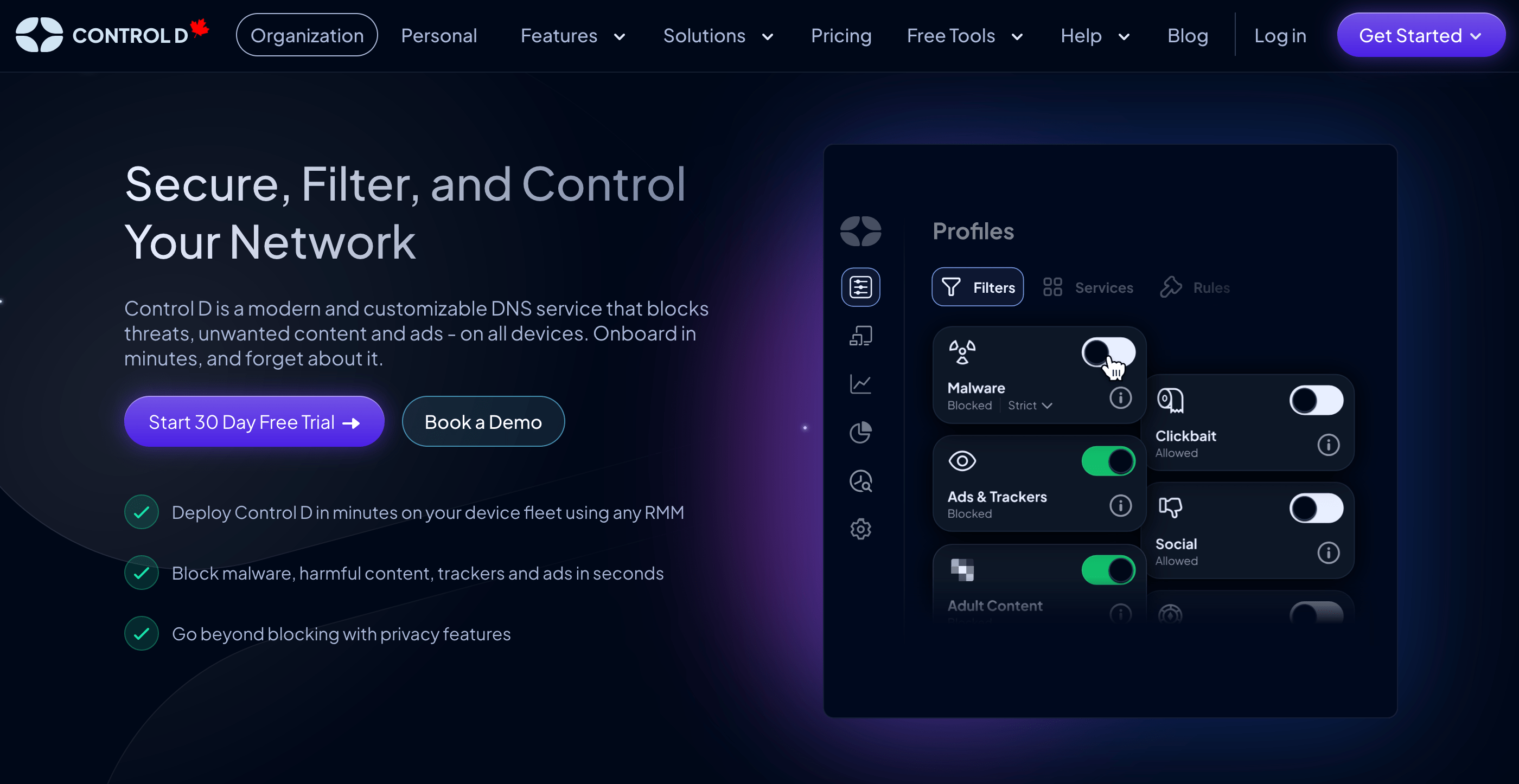
Traditional security often waits for a file to land on a device before it starts a scan. Control D stops the process earlier by managing the DNS queries. These are the digital requests that translate human-readable domain names like website.com into IP addresses.
Neutralizing AI and Autonomous Agents
AI-driven malware uses automation to find vulnerabilities and move through networks without human help. Control D interrupts this cycle by identifying the specific mechanisms these agents use to “call home”. For example:
- Command-and-Control (C2) Blocking: Most modern malware needs to talk to a C2 server (a remote computer used by hackers to send instructions) to receive tasks or encryption keys. Control D identifies these malicious domains in real-time and refuses to resolve them.
- AI-Powered Threat Intelligence: We don't just use static lists. Our AI Malware Filter uses machine learning to spot new, never-before-seen malicious domains based on their registration patterns and behavioral signatures.
- Stopping "Patient Zero": By blocking the initial request to a malicious site, you prevent the malware loader from being downloaded in the first place, ensuring the infection never starts.
Combating Fileless and Memory-Only Attacks
Because fileless attacks live in your system's RAM (temporary memory) or use built-in tools like PowerShell, they're invisible to standard file scanners. Control D helps in the following ways?
- Behavioral Network Visibility: Fileless scripts still need to exfiltrate data or download secondary payloads. Control D blocks these outbound requests, effectively "blinding" the script.
- DNS Tunneling Prevention: Attackers sometimes try to hide stolen data inside DNS queries themselves, a tactic known as DNS tunneling. Control D’s advanced analytics identify these high-frequency, non-standard queries and shut them down.
Securing Mobile and Remote Workforces
With the rise of Bring Your Own Device, corporate security often stops at the office door. Control D extends this protection to any device, anywhere:
- Roaming Clients: You can install Control D on mobile devices and laptops to ensure they're protected on home Wi-Fi or public hotspots, not just in the office.
- Zero Trust Ready: Our platform supports a Zero Trust architecture by enabling granular profile creation. You can grant specific access to a developer while keeping a sales team member on a more restrictive policy, reducing the "blast radius" if one device is compromised.
- Legacy System Shielding: For manufacturing or public sector groups using older equipment that can't run modern antivirus software, Control D provides a network-wide shield at the router level, blocking threats before they reach those vulnerable machines.
Looking Ahead
Malware is trending toward autonomy. It will move faster, probe more widely, and blend into normal traffic with less human effort behind it. The practical takeaway is simple: your defenses have to work earlier in the chain and keep working when devices leave the office.
DNS-layer control is one of the few levers that still scales cleanly against that shift. With Control D, you can block malicious domains before payloads land, disrupt command-and-control, and apply the same policies across roaming laptops and phones. Head into 2026 with that foundation, and keep tightening the basics around it: patching, backups, identity hardening, and training. The threats will keep evolving, but you can keep shrinking their room to operate.
Research Cited:
1. Aon
- Aon Cyber 2026: Evolving Threats Demand Strategic Leadership
- Website: https://www.aon.com/en/insights/articles/cyber-2026-evolving-threats-demand-strategic-leadership
- Known for cyber risk insights and strategic leadership guidance.
2. Verizon
- Verizon 2025 Data Breach Investigations Report (DBIR)
- Website: https://www.verizon.com/business/resources/reports/dbir/
- Known for the annual DBIR and breach investigation analysis.
3. Check Point Software
- The State of Global Cyber Security 2025
- Website: https://www.checkpoint.com/security-report/
- Known for annual global cybersecurity reporting and threat analysis.
4. IBM
- Cost of a Data Breach Report 2025
- Website: https://www.ibm.com/reports/data-breach
- Known for annual data breach cost analysis and security research.
5. CrowdStrike
- 2025 Global Threat Report
- Website: https://www.crowdstrike.com/global-threat-report/
- Known for annual threat intelligence reporting and adversary insights.
6. SonicWall
- 2025 Cyber Threat Report
- Website: https://www.sonicwall.com/2025-cyber-threat-report/
- Known for cyber threat reporting and malware/ransomware trend analysis.
7. Sophos
- The State of Ransomware 2025
- Website: https://www.sophos.com/en-us/content/state-of-ransomware
- Known for annual ransomware research and incident trend reporting.
8. Microsoft
- Microsoft Digital Defense Report 2025
- Website: https://www.microsoft.com/en-us/security/business/microsoft-digital-defense-report-2025
- Known for digital defense research and global cyber threat insights.
9. ENISA
- ENISA Threat Landscape 2025
- Website: https://www.enisa.europa.eu/publications/enisa-threat-landscape-2025
- Known for European cyber threat landscape analysis and policy-focused research.
10. Zscaler ThreatLabz
- Zscaler ThreatLabz 2025 Phishing Report
- Website: https://www.zscaler.com/blogs/security-research/zscaler-threatlabz-2025-phishing-report
- Known for phishing research and cloud security threat intelligence.
11. World Economic Forum
- Global Cybersecurity Outlook 2026
- Website: https://reports.weforum.org/docs/WEF_Global_Cybersecurity_Outlook_2026.pdf
- Known for global cybersecurity outlook reporting and executive-level risk analysis.
12. Statista
- Cyber Crime and Cybersecurity Worldwide
- Website: https://www.statista.com/topics/2588/cyber-crime-and-cyber-security/
- Known for cybersecurity statistics, market data, and topic overviews.
13. Canadian Centre for Cyber Security
- National Cyber Threat Assessment 2025–2026
- Website: https://www.cyber.gc.ca/en/guidance/national-cyber-threat-assessment-2025-2026
- Known for national cyber threat assessments and Canadian government guidance.
14. CISA
- CISA Alerts & Tips
- Website: https://www.cisa.gov/news-events/cybersecurity-advisories
- Known for cybersecurity advisories, alerts, and practical guidance.
15. HIPAA Journal
- Healthcare Cybersecurity Report 2025
- Website: https://www.hipaajournal.com/healthcare-cybersecurity-report/
- Known for healthcare cybersecurity coverage and compliance-focused reporting.
16. EdTech Magazine
- K-12 Cybersecurity Trends
- Website: https://edtechmagazine.com/k12/
- Known for K-12 technology coverage and cybersecurity trend reporting.
17. American Bar Association
- 2025 Cybersecurity Survey
- Website: https://www.americanbar.org/groups/law_practice/publications/techreport/https://edtechmagazine.com/k12/
- Known for legal industry technology surveys and cybersecurity reporting.